


MedCBO helps physicians launch, stabilize, and grow independent practices with integrated support across startup planning, payer contracting, credentialing, revenue cycle, finance, compliance, and operations.

MedCBO helps physicians launch, operate, stabilize, and scale independent practices without giving up ownership, clinical autonomy, or decision-making control. Most physicians are not held back by clinical skill; they are held back by the business infrastructure required to run a modern practice: credentialing, payer enrollment, IPA/ACO/CIN strategies and partnerships, revenue cycle, finance, HR, compliance, technology, staffing, vendor management, and daily operations.
MedCBO brings those pieces together through one coordinated support model. Instead of asking physicians to manage a patchwork of disconnected consultants, billing companies, software vendors, and fractional contractors, we provide an integrated business infrastructure team that helps build the strategy, implement the systems, and do the operational work alongside the practice.
Our model supports independent physicians through revenue cycle management, credentialing and payer contracting, accounting and financial infrastructure, HR and payroll support, compliance, EHR and technology solutions, startup planning, practice operations, and growth strategy. For physicians navigating Corporate Practice of Medicine requirements, ownership structures, or the transition out of employment, MedCBO helps create a state-compliant business framework that protects physician leadership while making independence more operationally realistic.
The result is a simpler path to independence: physicians keep control of the medicine, while MedCBO supports the business behind it. Whether you are starting a new practice, stabilizing an existing group, expanding service lines, or building a multi-provider model, MedCBO gives you the infrastructure to move forward with clarity, confidence, and support.
MedCBO brings together the operational infrastructure physicians need to launch, stabilize, and grow independent practices without managing multiple disconnected vendors, consultants, and platforms. Our integrated support model combines revenue cycle management, payer contracting and/or partnerhips, finance, HR, compliance, technology, credentialing, analytics, and operational strategy into one coordinated ecosystem designed specifically for healthcare organizations.
Whether supporting a startup clinic, a growing multi-provider group, or an established organization navigating operational complexity, MedCBO helps physicians reduce administrative burden, improve operational visibility, and create a more sustainable path to long-term independence.



We believe independent practices function best when physicians are supported by a business infrastructure that works together as a single system — not a collection of disconnected vendors, consultants, and platforms. Our model is designed to reduce operational burden, simplify decision-making, and give physicians the support needed to focus on patient care, growth, and long-term sustainability.
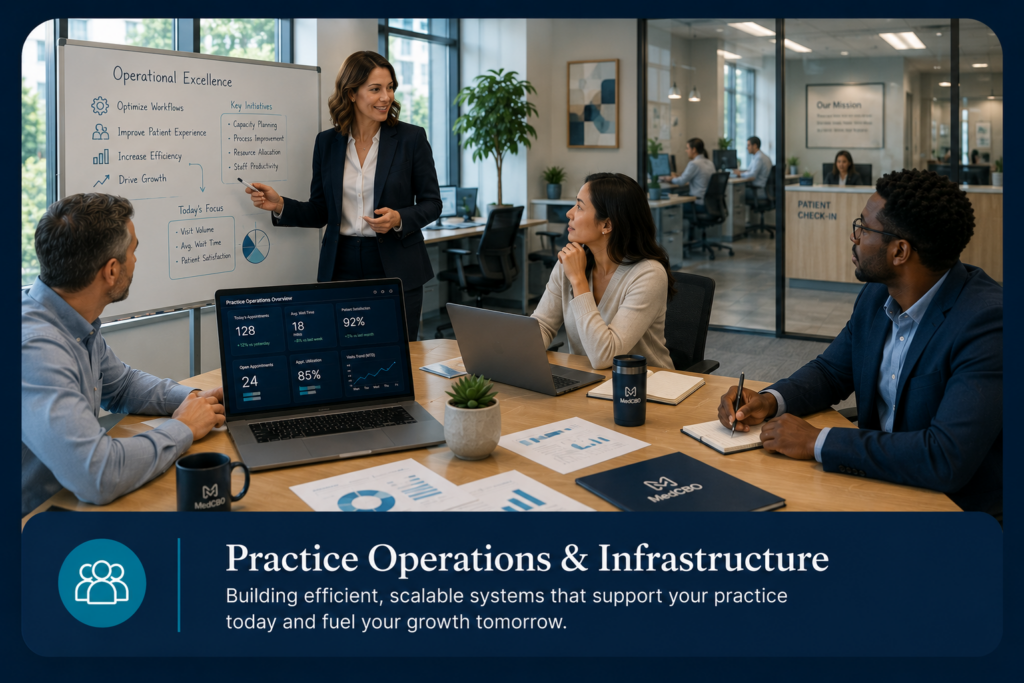
We work alongside physicians to build, implement, and manage the operational foundation of a modern medical practice. Rather than simply advising from the outside, MedCBO provides hands-on execution across revenue cycle management, credentialing, payer contracting, finance, HR, compliance, technology, and day-to-day practice operations.
From startup planning through long-term growth, our team functions as an integrated operational partner — helping physicians navigate the complexity of independent practice without sacrificing ownership, clinical autonomy, or strategic control.
Our coordinated model is designed to create:
Whether supporting a solo physician startup, a growing multi-provider group, or an established organization seeking operational stability, MedCBO brings the people, systems, and infrastructure together under one unified model designed specifically for independent healthcare organizations.


Independent practice is no longer just about opening a clinic.
It requires operational infrastructure, financial visibility, technology integration, staffing support, compliance oversight, payer strategy, and scalable systems that can evolve with the practice over time.
MedCBO was built to help physicians navigate that complexity without giving up ownership, autonomy, or long-term vision.








MedCBO was designed to help physicians navigate the operational complexity of modern healthcare without sacrificing ownership, autonomy, or long-term vision.
We begin with a strategic discovery conversation focused on your goals, operational needs, practice model, and long-term vision. These calls typically last 30–60 minutes depending on the scope of your questions and where you are in the planning process.
Whenever possible, we recommend joining from a computer so our team can walk you through a brief presentation covering MedCBO’s services, support model, pricing structure, and next steps. This also gives you an opportunity to ask early questions and better understand whether MedCBO is the right fit for your organization.
From there, we outline potential infrastructure needs, support pathways, and recommended next steps tailored to your practice.
No. MedCBO is designed to support physician independence — not replace it. Physicians maintain ownership, leadership, and clinical autonomy while MedCBO provides the operational infrastructure behind the practice.
Many states have Corporate Practice of Medicine (CPOM) laws that are designed to protect physician independence by limiting non-physician ownership and control over medical decision-making. While CPOM requirements vary by state, MedCBO approaches physician ownership and clinical autonomy as a foundational principle across all 50 states, regardless of whether a state has strict CPOM regulations.
MedCBO does not purchase ownership in physician practices, direct patient care decisions, or control clinical judgment. Our role is to support the business infrastructure surrounding the practice through services such as revenue cycle management, credentialing, finance, HR, compliance, technology, analytics, and operational support.
This structure allows physicians to maintain control of the medicine while building more operationally sustainable and scalable organizations.
Not necessarily. Patient retention during physician transitions is influenced by employment agreements, non-solicitation clauses, payer participation, geography, scheduling access, marketing, health-system retention efforts, and patient behavior patterns.
While some patients may choose to follow their physician, independent practices should not rely solely on projected migration from an existing employer or group when developing financial models or growth assumptions. MedCBO encourages conservative forecasting and diversified patient acquisition planning during startup development.
Most independent practices require startup capital for expenses such as buildout, staffing, technology, credentialing, equipment, insurance, and operating reserves during the early growth period. While MedCBO does not fund practices, we work with banking and lending partners that may support qualified physicians and organizations with startup and operational financing.
Financing approval is typically based on several factors, including personal credit profile, liquidity, debt-to-income ratios, specialty, projected revenue, and overall business plan viability. While requirements vary by lender and project type, physicians commonly need:
It is also important to understand that personal debt-to-income ratio and practice debt coverage are evaluated differently. Personal debt-to-income focuses on the physician’s existing personal obligations relative to income, while practice underwriting evaluates whether the combined practice revenue can reasonably support projected operating expenses, staffing, loan obligations, and ongoing growth needs.
MedCBO works with physicians during the planning process to help assess operational feasibility, startup assumptions, infrastructure needs, and financial readiness before launch.
Yes — but not every model is operationally or financially viable in every market.
Pure telemedicine and concierge models often require significant marketing investment, strong differentiation, existing patient loyalty, or niche positioning to achieve sustainable growth. Many payers, health systems, and national platforms already operate large-scale virtual care networks with substantial infrastructure and referral advantages.
MedCBO evaluates these models carefully to determine whether projected revenue, patient acquisition strategy, and operational structure align with long-term sustainability and minimum infrastructure requirements.
Both. We support de novo startups, transitioning physicians, and established practices seeking operational stabilization, growth support, or infrastructure modernization.
In most cases, yes. MedCBO supports physicians and healthcare organizations across all 50 states, including physicians opening practices outside of their current state of residence. However, healthcare operations, ownership structures, licensing requirements, payer enrollment rules, and Corporate Practice of Medicine (CPOM) laws can vary significantly by state.
When physicians open practices in new states, factors such as medical licensure, entity structure, payer participation, staffing regulations, telemedicine requirements, and local market dynamics must all be evaluated during the planning process. MedCBO works with physicians to help navigate these operational and regulatory considerations before launch.
For physicians operating across multiple states, insurance participation and payer contracting can also become more complex. Credentialing, enrollment, and reimbursement are often managed separately by state and by payer network, even when the same insurance company operates nationally. In many cases, physicians may need:
MedCBO helps physicians evaluate these requirements as part of feasibility, startup, and expansion planning to ensure the operational infrastructure can support long-term growth across multiple markets.
Yes. MedCBO regularly works with Independent Physician Associations (IPAs), Accountable Care Organizations (ACOs), Clinically Integrated Networks (CINs), and other physician alignment or value-based care organizations on behalf of our client practices.
For physicians who may benefit from one of these networks, MedCBO helps identify appropriate opportunities, coordinate communication, gather required provider and practice information, and support the intake, credentialing, enrollment, and contracting process. Our goal is to make participation easier for the physician while helping the IPA, ACO, CIN, or network partner receive complete and accurate information as efficiently as possible.
MedCBO does not replace these organizations. We support the operational infrastructure of the individual practice while helping the physician connect with aligned partners when appropriate. If a payer, contract, or enrollment need is not represented through the IPA, ACO, CIN, or network arrangement, MedCBO can support supplemental payer enrollment, credentialing, and contract negotiation as needed.
In many cases, physicians can work with both MedCBO and a network partner simultaneously, allowing the practice to maintain strong operational support while also participating in broader contracting, value-based care, or physician alignment initiatives.